
Text to Morse
Type a message and see it instantly in International Morse code. Play it as sound at any speed from 5 to 40 words per minute, add Farnsworth spacing for learning, watch it flash as a light signal or download it as a WAV file. You can also paste dots and dashes to decode Morse back into text.
- Free to use
- No sign-up
- Runs in your browser
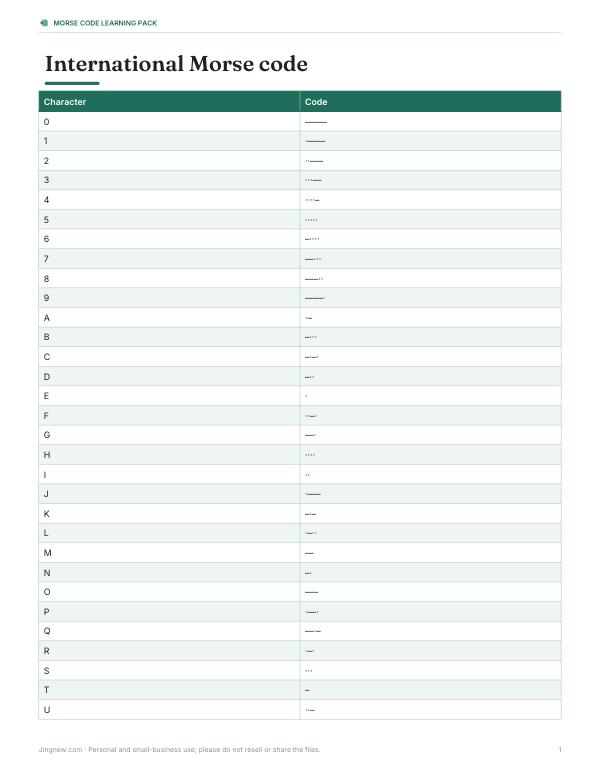
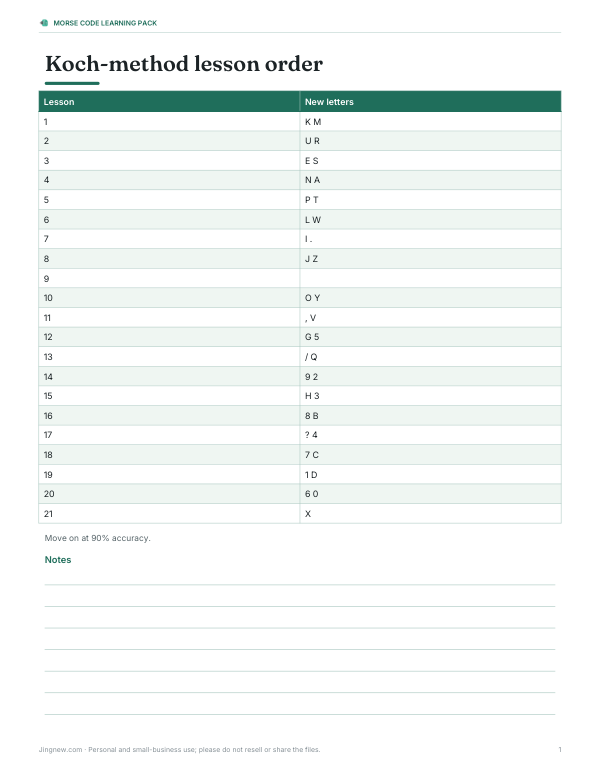
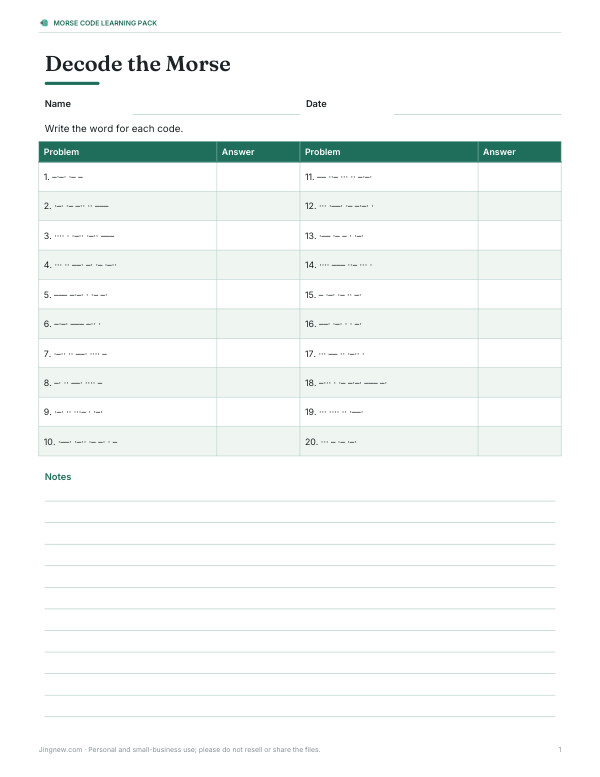
Text to Morse translator
Morse Code Learning Pack
Printable Morse code learning set: chart, Koch-method lesson plan, 20 practice decoding worksheets with answers and a practice log.
- Chart (PDF)
- Lesson plan (PDF)
- Decoding worksheet (PDF, DOCX)
- Practice log (PDF, XLSX)
Formats: PDF, DOCX, XLSX. Instant download after payment (link valid 72 hours, up to 5 downloads). AI-assisted: the templates were drafted with AI help and reviewed and laid out before publishing.
$5.00 USD, one-time 4 files · about $1.25 each
- Instant download
- 7-day refund
- Secure checkout by Stripe
7-day money-back guarantee. Full refund within 7 days of purchase, even after you download.
Free sample: Koch Lesson Plan (PDF, 69 KB)
Full refund within 7 days — see the refund policy and license.
Free printables
Single sheets you can print right now, no sign-up. The full pack adds every sheet in one download plus the editable files.
 Printable Morse Practice Log
International Morse code chart
| Character | Code | Character | Code | Character | Code |
|---|---|---|---|---|---|
| 0 | ––––– | I | ·· | . | ·–·–·– |
| 1 | ·–––– | J | ·––– | , | ––··–– |
| 2 | ··––– | K | –·– | ? | ··––·· |
| 3 | ···–– | L | ·–·· | ' | ·––––· |
| 4 | ····– | M | –– | ! | –·–·–– |
| 5 | ····· | N | –· | / | –··–· |
| 6 | –···· | O | ––– | ( | –·––· |
| 7 | ––··· | P | ·––· | ) | –·––·– |
| 8 | –––·· | Q | ––·– | & | ·–··· |
| 9 | ––––· | R | ·–· | : | –––··· |
| A | ·– | S | ··· | ; | –·–·–· |
| B | –··· | T | – | = | –···– |
| C | –·–· | U | ··– | + | ·–·–· |
| D | –·· | V | ···– | - | –····– |
| E | · | W | ·–– | _ | ··––·– |
| F | ··–· | X | –··– | " | ·–··–· |
| G | ––· | Y | –·–– | $ | ···–··– |
| H | ···· | Z | ––·· | @ | ·––·–· |
This is International Morse code as standardised by the ITU. It has no separate lower-case letters, and some characters (such as accented letters) have extra codes not shown here.
How Morse code timing works
| Element | Length |
|---|---|
| Dot (dit) | 1 unit |
| Dash (dah) | 3 units |
| Gap between dots and dashes in a letter | 1 unit |
| Gap between letters | 3 units |
| Gap between words | 7 units |
Speed is measured in words per minute using the standard word “PARIS”, which is exactly 50 units long including the word gap. So at 20 WPM one unit — one dot — lasts 1.2 ÷ 20 = 0.06 seconds, or 60 milliseconds.
Farnsworth spacing for learners
Learning Morse slowly, one dot at a time, encourages counting dots and dashes rather than hearing each letter as a single sound pattern. Farnsworth timing, named after Donald R. Farnsworth, sends each character at a faster speed (say 18–20 WPM) but stretches the gaps between characters and words so the overall speed is slower (say 10 WPM). Learners get used to the rhythm of each letter at real speed while still having time to recognise it. Set the character speed higher than the effective speed to use it.
How to use the translator
- Type or paste your text in the top box — the Morse code appears as you type.
- Letters are separated by spaces and words by a slash ( / ).
- To decode, type dots and dashes in the Morse box; the text updates above. Unknown codes show as “?”.
- Set the character and effective speeds, and the tone.
- Play the message as sound, flash it on the light panel, or download a WAV file.
Everything runs in your browser — nothing is uploaded.
Worked example: SOS
SOS is three dots, three dashes, three dots: ··· ––– ···. As a distress signal it is sent as one continuous sequence without the usual gaps between letters. At 20 WPM each dot lasts 60 ms and each dash 180 ms. “SOS HELLO WORLD” comes out as 13 letters with 25 dots and 16 dashes, and at 20 WPM the translator shows it takes about 8.7 seconds to play; drop the effective speed to 10 WPM with Farnsworth spacing and it stretches to about 15.6 seconds while each letter still sounds exactly the same.
Tips for learning Morse code
- Learn by sound, not by looking at dots and dashes on paper.
- Start with a few letters at 18–20 WPM character speed with Farnsworth gaps (the Koch method).
- Add a new letter when you copy 90% correctly.
- Practise ten to fifteen minutes a day rather than long sessions.
- Say letters as “dit” and “dah” — E is “dit”, T is “dah”, A is “di-dah”.
- Listen to real on-air Morse once you know all the letters.
Where Morse is still used
Morse code is no longer used for commercial maritime distress (replaced by satellite systems in 1999), but it is very much alive in amateur radio, where “CW” operators value its ability to get through weak signals and noise. Aircraft navigation beacons identify themselves in Morse, and it is a lifeline for some people with disabilities who use switch-based Morse input to type. It also appears in escape rooms, puzzles, jewellery and tattoos.
A short history
Samuel Morse and Alfred Vail developed an electrical telegraph code in the United States in the late 1830s and 1840s. Their original “American Morse” used spaces inside some letters and dashes of different lengths. In 1848 Friedrich Gerke simplified it for German telegraph lines, and that version, with a few changes, became International Morse code in 1865. It carried news, business and diplomatic messages across continents and under oceans for a century, and radio operators on ships used it from the early 1900s until satellite systems replaced it.
Common mistakes when translating
The most common errors are running letters together without a gap, which changes their meaning (“..” then “-” is I and T, but “..-” is U), and confusing letter gaps with word gaps. When you decode, make sure each letter is separated by a single space and each word by a slash.
Morse by light and sound
Morse can be sent by anything that switches on and off: a buzzer, a torch, a ship’s signal lamp, a car horn or a tap on a pipe. Signal lamps on navy ships still use it for silent communication. The flash panel here shows the same timing as the audio, so you can practise reading light signals, and the WAV download lets you use the sound in a video, a game or a puzzle.
Prosigns and abbreviations
| Signal | Meaning |
|---|---|
| SOS (···–––···) | Distress |
| AR (·–·–·) | End of message |
| SK (···–·–) | End of contact |
| BT (–···–) | New paragraph / break |
| K | Go ahead, invitation to transmit |
| CQ | Calling any station |
| 73 | Best regards |
Frequently asked questions
How do I convert text to Morse code?
Type it in the text box — each letter becomes dots and dashes, separated by spaces, with slashes between words.
How do I decode Morse code?
Type or paste dots and dashes in the Morse box; separate letters with spaces and words with a slash.
What is SOS in Morse code?
··· ––– ··· — three dots, three dashes, three dots.
How fast is Morse code?
Beginners often copy 5–15 WPM; experienced operators 20–40 WPM or more.
Can I download the Morse audio?
Yes, as a WAV file.
Does it support lowercase?
Morse has no case; lowercase is converted to uppercase.
What does the slash mean in Morse translations?
It marks the gap between words; letters are separated by single spaces.